Note: I believe this lesson is a bit too detailed, if you want to learn the script fast then just see the tables, skip anything you don't understand and one thing I really recommend doing is just skip this page entirely and go take the quiz even if you don't know the script. Make mistakes, learn from your mistakes and then return to this page when you are confused about something.
That will save a lot of your time hopefully. But if you are a Dai Ahom enthusiast with lot of free time then read the whole thing
Consonants
There are 20 consonants in Dai Ahom language called to māe līk tái or the “main body of Tai Alphabet,” as the below table lists out in detail.
| Consonant | Example | |
|---|---|---|

![]() |
k (g) | gài (kj!) - chicken |
![]() |
x (x) | xài (xj!) - egg |
![]() |
[ (ng) | ngú ([U#) - snake |
![]() |
n (n) | nûk (nukq$) - bird |
![]() |
t (t) | tào (tw!) - tortoise |
![]() |
p (p) | pa (pa) - fish |
![]() |
f (ph) | phērng (fE[q@) - bee |
![]() |
B (b) | bāan (B,nq@) - village |
![]() |
b (w) | wán (bnq#) - sun |
![]() |
m (m) | ma (ma) - dog |
![]() |
y (y) | yúng (yu[q#) - mosquito |
![]() |
c (ts) | tsâang (c,[q$) - elephant |
![]() |
v (th) | thai (vj) - plough |
![]() |
r (r) | rérn (rEnq#) - house |
![]() |
l (l) | líng (li[q#) - monkey |
![]() |
s (s) | saeng (sV[q) - diamond |
![]() |
N (ny) | nyā (Na@) - grass |
![]() |
h (h) | hàan (h,nq!) - goose |
![]() |
A (a) | òi (Aoj!) - sugarcane |
![]() |
d (d) | doi (doj) - hill |
If you still haven't memorized them, then you can take short quiz. Since this is also
an academic article here is a classification of the consonants based on their places of articulation
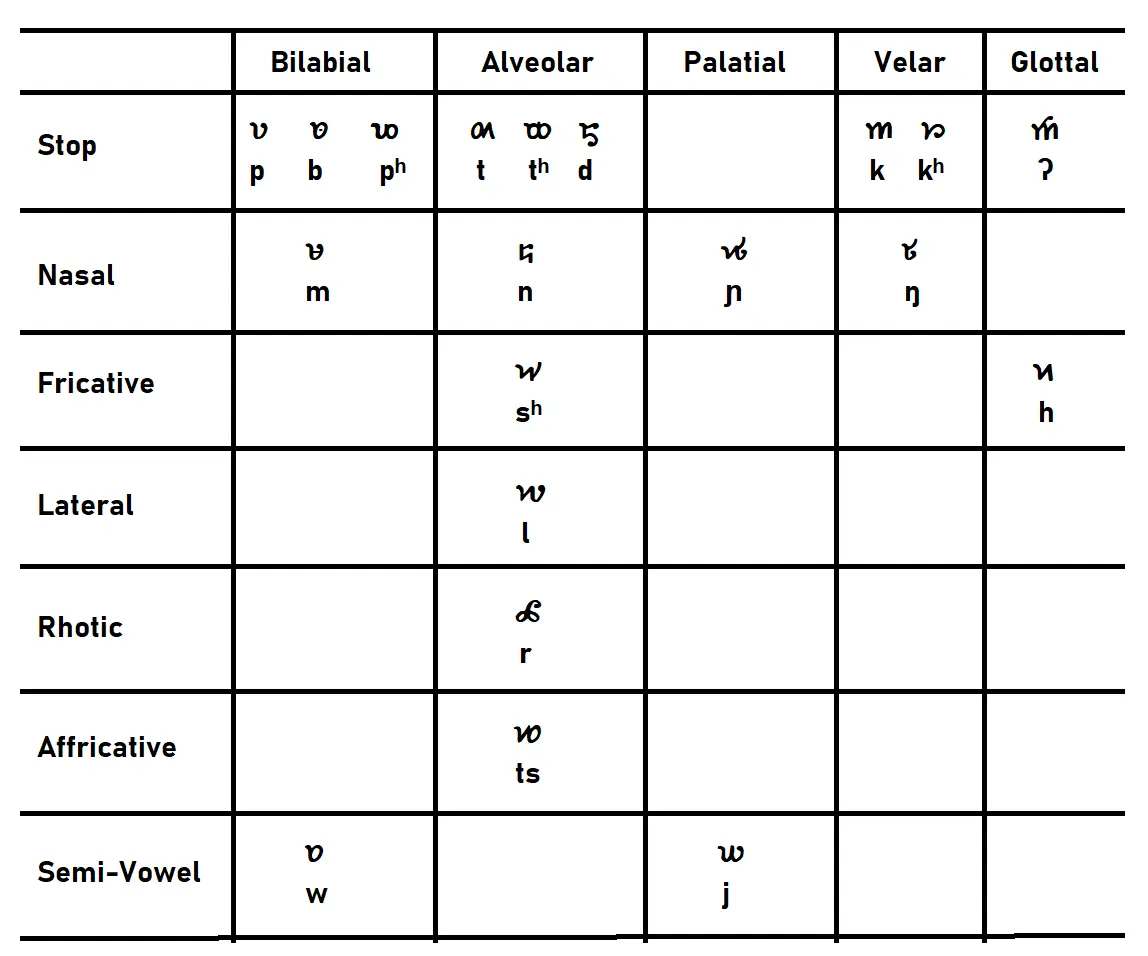
A lot of Tai people confuse between k and kha, hence distinction is made by written them as 'g' and 'x', infact
[g] and [k] are the same sounds in Tai language which is why you must have heard Tai people pronouncing 'dog' as 'dok'.
But anyways the focus here shouldn't be on romanization but learning the script itself. Cause once you learn script
you can adapt to any romanization thrown at you. Also an important thing to note is that of the 20 consonants
only eight consonants can be in the ending position namely - k, ng, n, t, p, w, m, ny. Any other consonant in ending should
be read as approximate of these eight finals. For eg., làed should be read as làet, káb should be read as káp ,
râx as râk and so on.. Just consider this as fancy writing and move on.
Vowels
There are 11 “pure vowels” in Ahom called māe káp ngāo or literally meaning “body-meet-foundation”
as consonants are the main body of Tai Alphabet while Vowels are the foundation that only make sense when they meet with the body.
We here use the Ahom consonant (māe) ‘𑜒’ to read them all
| Vowel | Example | |
|---|---|---|
![]() |
A (a) | râk (rkq$) - love |
![]() |
Aa (aa) | ga (ka) - crow |
![]() |
Ai (i) | mīt (mitq@) - knife |
![]() |
AI (ii) | dii (dI) - good |
![]() |
Au (u) | qún (kunq#) - person |
![]() |
AU (uu) | muu (mU) - pig |
![]() |
eA (e) | mé (em#) - wife |
![]() |
eA] (ae) | māe (em]@) - mother |
![]() |
AUw (o) | ho (hUw) - head |
![]() |
eAa (aw) | haw (eha) - palace |
![]() |
AEw (er) | ser (sEw) - tiger |
The er (𑜒𑜢𑜤𑜈𑜫) sound is same as ‘er’ in cheater with r-silent, we call it the schwa /ǝ/ sound.
If you know Hindi language you might already be familiar with this vowel.
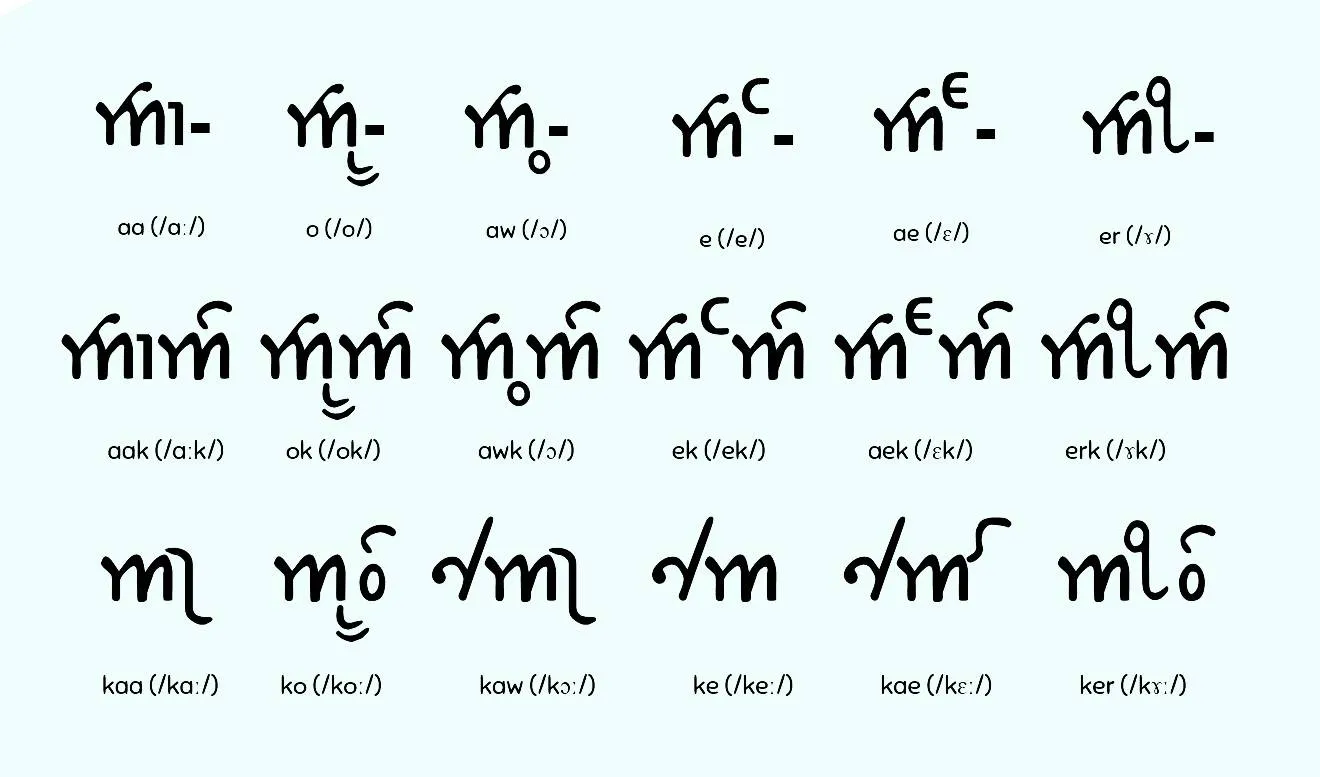
Next comes the ‘o’ vs ‘aw’, the former o (𑜒𑜥𑜈𑜫) sound is more like the Hindi
o (or ‘o’ as in go, so, etc) while the aw (𑜒𑜦𑜡) sound is more like the Assamese o
(‘aw’ as in saw, awesome, etc). It is also the same ‘aw’ in Aizawl.
We can also write ‘aw’ as ‘or’ as some Thai people actually do (khorp, norng, etc)
Finally the most complex still is the ‘e’ vs ‘ae’ vowel which might sound the same to you but are different.
‘e’ is the sound of e as in bed while ‘ae’ is the sound of a as in ham. But in actual
spoken language we often just say ‘ae’ as ‘ie’ (like lieng, sieng, etc)
Here is the Dai Ahom Vowel Trapezium for linguistics-nerds
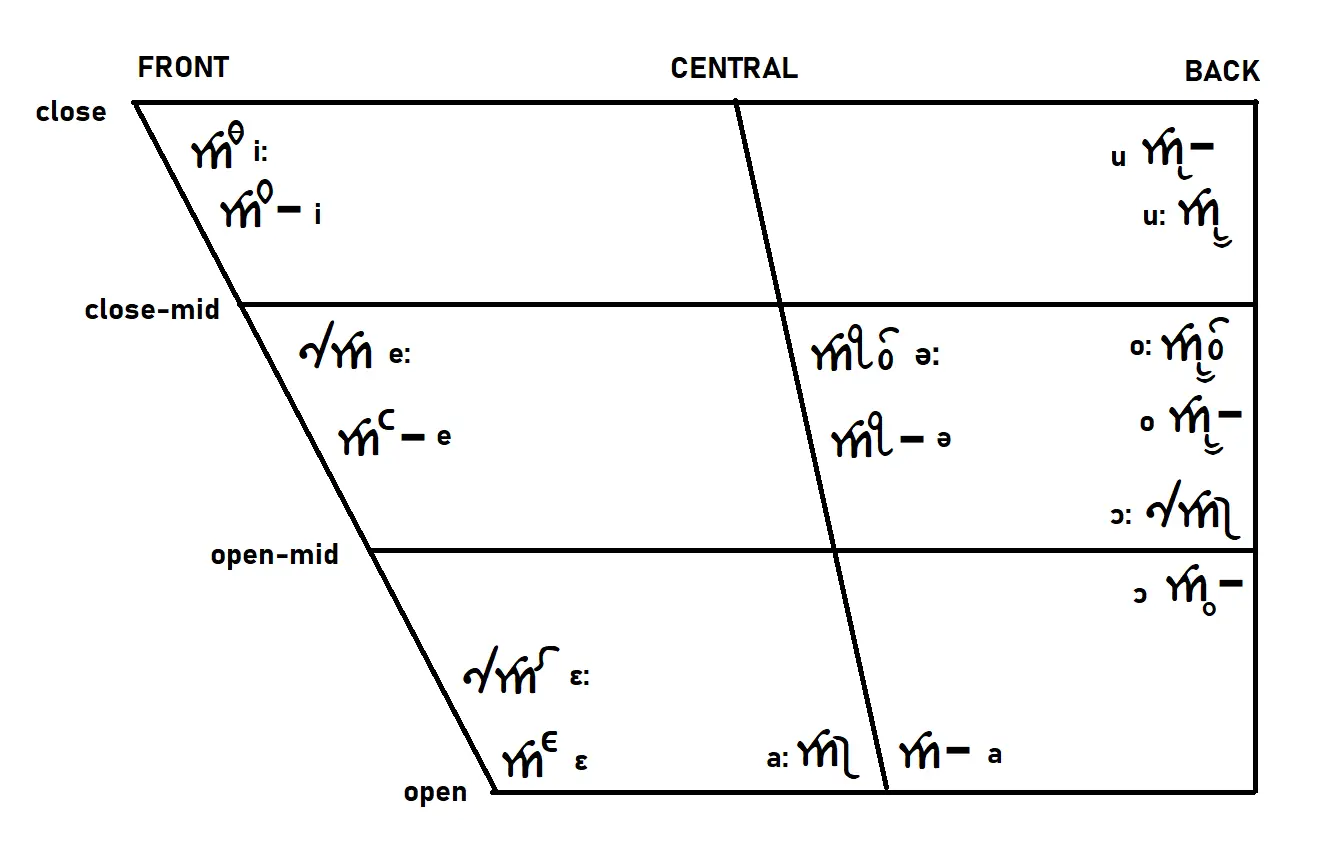
Now comes the very important part. As you can see all vowels use different graphemes when in final and
medial position for example gin (𑜀𑜢𑜃𑜫) and di (𑜓𑜣) both use different
graphemes for ‘i’. Now one is short ‘i’ (medial) and one is long ‘ii’ (final) and long vowels cannot be in
medial position except for ‘aa’ where we use a different vowel to represent it along with ‘e’, ‘ae’, ‘o’, ‘aw’, and ‘er.’
The following table will make it clear
| Vowel | Example | |
|---|---|---|
![]() |
A,- (aa) | gàat (k,tq!) - mart |
![]() |
AC- (e) | tsét (cCtq#) - seven |
![]() |
AV- (ae) | tāem (tVmq@) - write |
![]() |
AU- (o) | son (sUnq) - garden |
![]() |
Ao- (aw) | sawng (so[q) - two |
![]() |
AE- (er) | mérng (mE[q#) - country |
If you notice, then the same grapheme 𑜥 is used to represent two different vowels u (𑜒𑜥) and o (𑜒𑜥-)
distinguished by its placement in medial and final position. If you do some word reading quizzes you will completely get it within
few minutes.
Also if you know Thai, you must have noticed how there is no distinction between long vowels and short vowels in final position. This is
because 𑜀𑜢 𑜀𑜤 𑜀 these are not even words. So phii 𑜇𑜣 can be written as phi,
muu 𑜉𑜥 can be written as just mu,
and kaa 𑜀𑜡 can be written as just ka. This makes Dai Ahom probably the most easiest
Tai languages to learn especially when compared to Thai because you can learn the entire script in just ten-twenty minutes
If you want to experiment with romanization then go to Ahom Converter and play around a bit
until you have learnt all about vowels and also take the quiz to test all that you have
learned till now. And finally to practice your typing you can go to Ahom Keyboard and try
writing your name, your family's name, etc.
We write medial aa as า, e as -𑜦 and medial ae as 𑜦𑜦 in Unicode because we don't have these glyphs currently in our Unicode Block. But we have plans to make an official request to the Unicode Committee to get these graphemes very soon, along with the tonal marks. For now you can simply use the roman script or the workaround font to unicode with Ahom Converter
Diphthongs
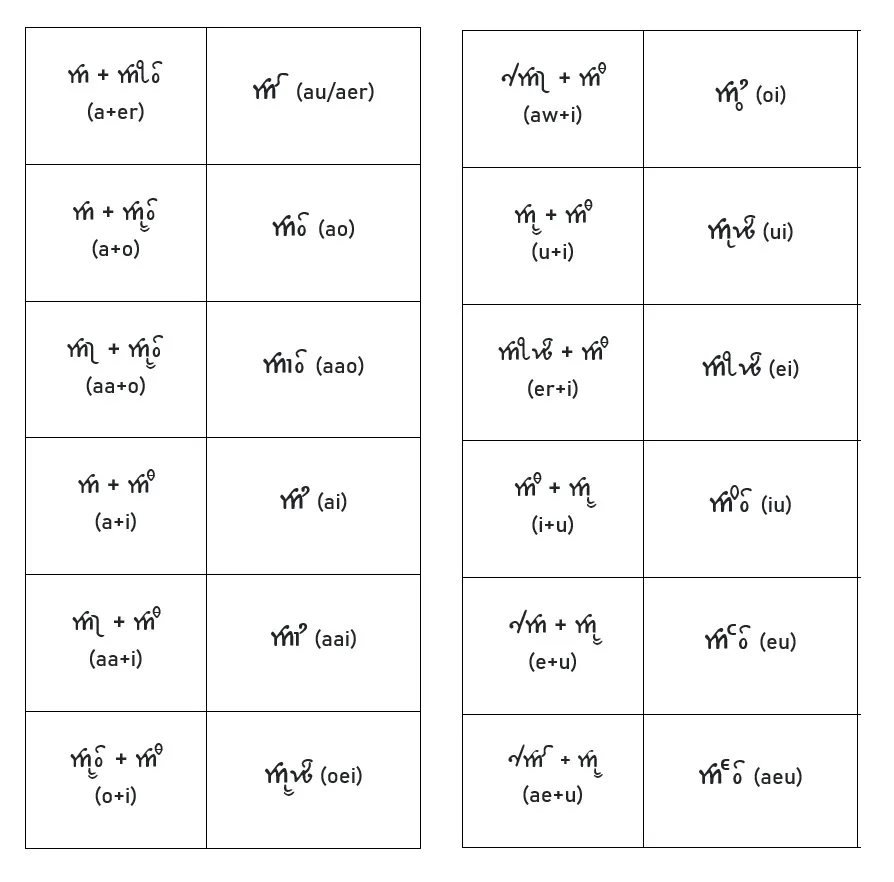
Aside from these 11 vowels, there is also something called māe káp sâwn or dipthongs, that are formed by combining two vowels
(or placing them on top of one another as word sâwn means).
We have twelve of these diphthongs which we read with ‘𑜒’
| Diphthong | Example | |
|---|---|---|
![]() |
A] (au) | máu (m]#) - you |
![]() |
Aw (ao) | qao (kw) - me |
![]() |
A,w (aao) | xaao (x,w) - white |
![]() |
Aj (ai) | phai (fj#) - fire |
![]() |
A,j (aai) | taai (t,j) - die |
![]() |
AuNq (ui) | kūi (kuNq@) - banana |
![]() |
AUNq (oei) | kóei (kUNq#) - only |
![]() |
Aoj (oi) | doi (doj) - hill |
![]() |
AENq (ei) | hei (hENq#) - hey |
![]() |
Aiw (iu) | phiu (fiw) - whistle |
![]() |
ACw (eu) | leu (lCw) - alone |
![]() |
AVw (aeu) | láeu (lVw#) - sword |
In Ahom manuscripts sometimes the sign-killer is not used perhaps for artistic reasons but they are absolutely compulsory
in modern Dai Ahom for clear reading. Also the shorthand -𑜪 basically appends the
-am phoneme to the consonant below it. It is just a shorthand of -𑜉𑜫 and not
a vowel like some people mistakenly call it.
Consonant Clusters
There are just four consonant clusters (māe káp seng sâwn) in Dai Ahom and only two of them are found in manuscripts (-la and -ra), while other two are recent inventions to write burmese and other tai words (-wa and -ia).
| Cluster | Example | |
|---|---|---|
![]() |
Ska (-ra) | phrá (Sfa#) - noble |
![]() |
kYa (-la) | klá (kYa) - indian |
![]() |
Aia (-ia) | kyàw (ekia!) - happy |
![]() |
Aoa (-wa) | kwáam (ko,M#) - word |
Tones
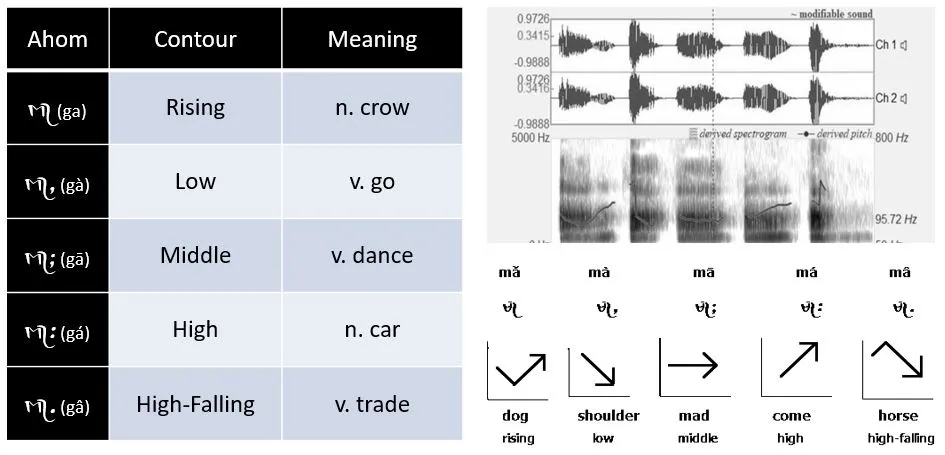
Finally you must have noticed what those commas and semicolons are. They are not your usual punctuation marks, they are your Shan tone marks
which were invented in late 1950s to improve Shan literacy. Otherwise before they too had the same problem of having
a toneless unreadable script which was only useful for priests who alone, knew what they were writing and no one else could read it. After
script reform, of Shan Hkamti Lao Mao etc all these scripts became highly phonetic and easy to read just like English. But due to some evil
people in the Ahom community and their internal politics we could never get a phonetic Ahom script.
Hopefully this new generation will solve the mistakes of previous generation and the position of Dai Ahom as a tonal language like all Tai languages are will be established. Enough
lecture, but what do we even mean by tones? And why are they so relevant?
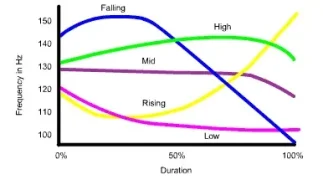
Tones (tón seng are the most important aspect of Tai languages, that distinguish one syllable from another that would otherwise
be considered the same word in a non tonal language. For example gài means a chicken, but gái means
a penis. gón means person but gōn means anus. If you are not careful you will completely be misunderstood
by a native Tai speaker as a person who only says vulgar things.
| Vowel | Example | |
|---|---|---|
![]() |
Aa (a) | ga (ka) - crow |
![]() |
Aa! (à) | gà (ka!) - go |
![]() |
Aa@ (ā) | gā (ka@) - dance |
![]() |
Aa# (á) | gá (ka#) - car |
![]() |
Aa$ (â) | gâ (ka$) - trade |
Some FAQs relating to the orthography will be answered in a separate article. We are building a pressure group to get unicode update. Will take some time. But donating to us won't take any time. We are not some big corporate with tons of cash. Your support is what keeps the website alive.
rw# AM! vukq! dI lEmq# likq@ rw# xEnq#
We must never forget our language.