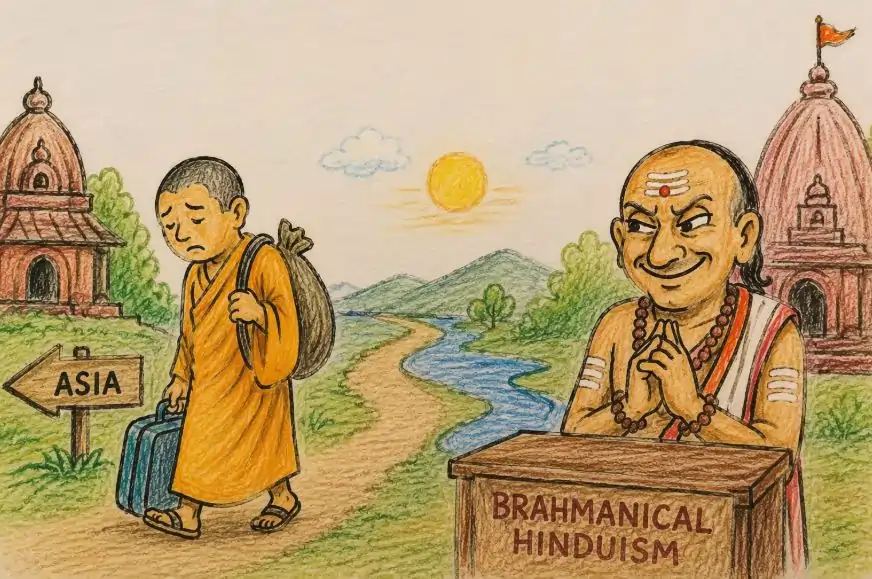
For most people today, Assam is associated with the Kamakhya Temple, Vaishnavite monasteries established by Sankardeva, and the rich traditions of Shaktism. But very few know that Assam also had a rich Buddhist history. The Buddhist name of Assam is Weshali, the place where Buddha gave his last sermons and also regarded by Tibetans as the place where Buddha died. But how did this great unifying religion completely disappear from Assam? We will learn in this article.
Early Buddhist Persecution in Kamarupa
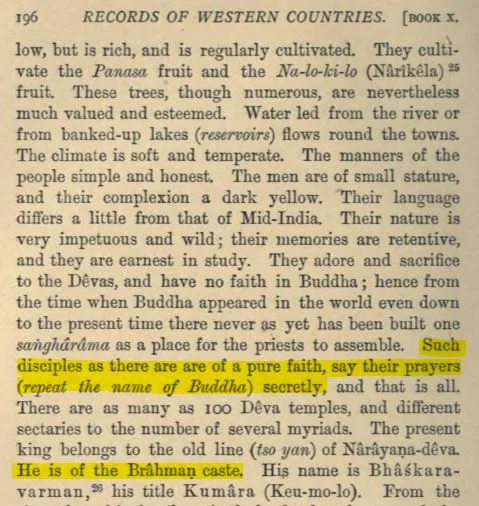
Historically speaking, Kamarupa was a Brahmanical Kingdom where Buddhists were actively persecuted. The first is proved by Nidhanpur copper-plate inscriptions where Brahmins from North India were given land grants by Bhaskarvarman who is described as belonging to local Mech Tribe (K.L Barua & SK Chatterji). And the latter is proved by Xuanzang's accounts of ancient Assam
Si-yu-ki, Buddhist Records of the Western World. Translated by Samuel Beal, 1884, p.196
Now Xuanzang calls Bhaskarvarman as Brahman but this should be translated as a Hindu as all Buddhists during this time used to call Brahmanism followers as Brahmans (remember that the word Hindu was not coined yet). What is important to note is that in his own words, Bhaskarvarman says to Xuanzhang that his own ancestors came from China and no Brahmin has origin in China hence the ethnicity of Bhaskarvarman was without a doubt Tibeto-Burman – but that is for another article. What is visible in this snippet is that Buddhists would have to say their prayers secretly. We have documented evidence that Buddhism was heavily persecuted in Bengal during the time of Shashanka (a contemporary of Bhaskarvarman) hence Buddhist persecution in Assam cannot be ruled out.
It is very probable that some RSS like organization was active in ancient India who persecuted anyone who criticized Hinduism or Vedic Religion and so Buddhists Charvakas and Ajivikas were their natural targets. Today you will not find a single traditional Buddhist Charvaka or Ajivika person in India. That's how heavily Hinduism persecuted these religions / philosphical schools.
Buddhist Monasteries to Hindu Temples
As it has already been said that there is not a single traditional Buddhist alive in India. The same place where Buddhism was started was also the same country where Buddhists were chased out and it was only because of its spread in Asia that we today know about Buddhism as a religion. Today lot of Indians take pride in this but they should know that it was not their mainstream Vedic Hindu religion but its exact rival religion that became famous in Japan and Korea. And in fact if Buddha was alive in modern India's political climate he would probably have been called an anti-Hindu because of his rejection of Vedas and Caste System.
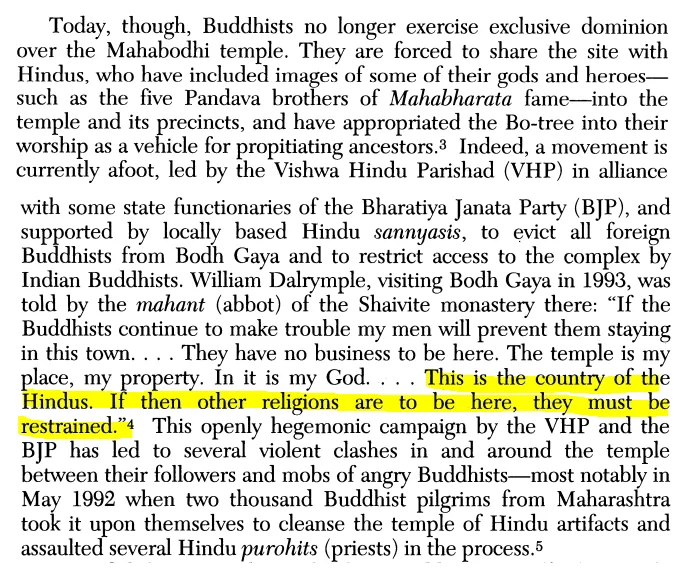
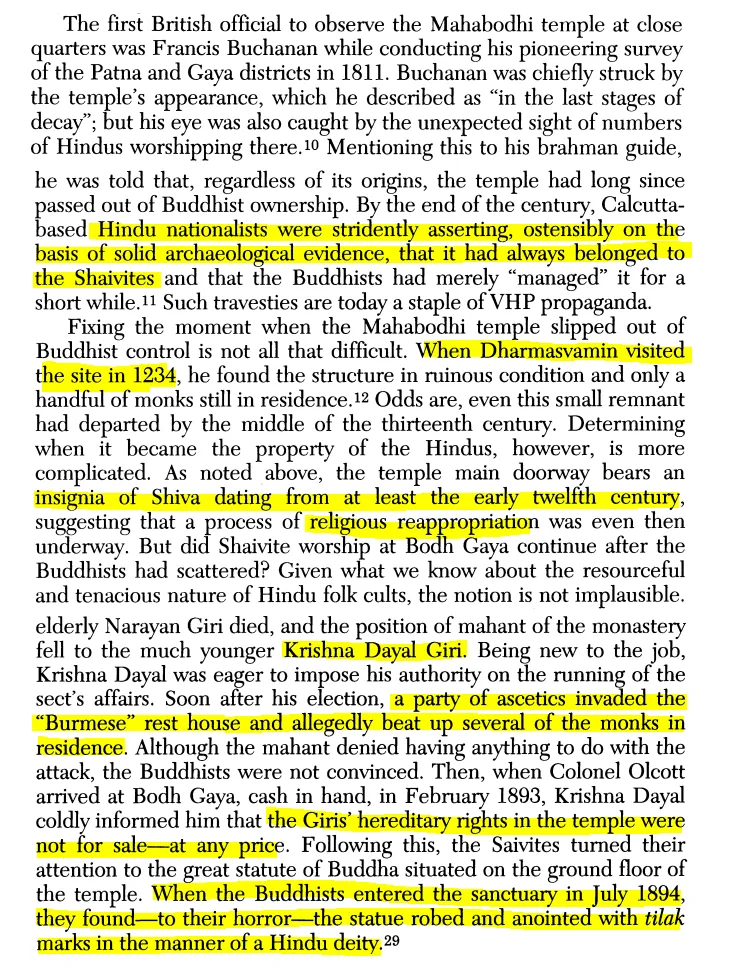
Even as recently as 1993, the Buddhists were called foreigners and Hindu Fundamentalist Abbots were publicly saying that India is a Hindu Country and all minority religions shall be suppressed (Ian Copland 2004)
Managing Religion in Colonial India: The British Raj and the Bodh Gaya Temple, Ian Copland, 2004
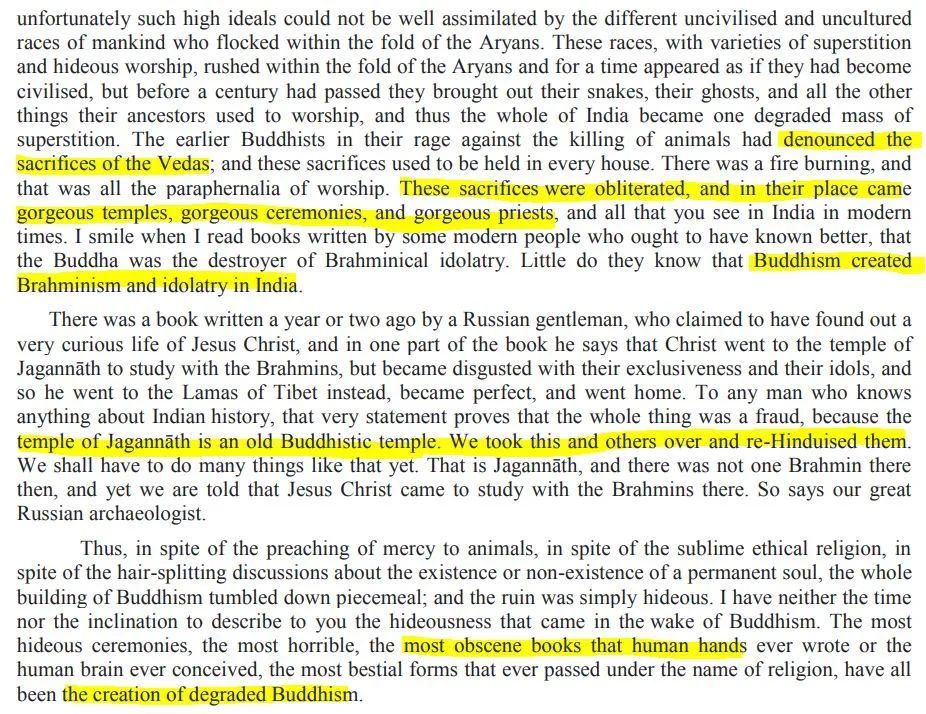
I cannot help but remember Swami Vivekananda's comments on Buddhism giving rise to Brahmanism in India because while earlier during Vedic times, religion was restricted only to the elites but Buddhism came and brought religion to whole masses. And later this competition between Buddhism and Brahmanism brought fore the most disgusting of Smritis and Tantras ever written by human hands. He also owns the Hindu appropriation of Buddhist temples such as Jagannath Puri
Swami Vivekananda theorizing Jagannath as Buddhist Site, Lectures from Colombo to Almora (1897)
Hindu Appropriation of Bodh Gaya
Jagannath Puri is not the only Hindu temple with Buddhist origin, what if I told you even the most sacred temple for Buddhists — the Bodh Gaya Temple in Bihar was also appropriated as a Shiva temple and there was a legal court battle fought over its ownership during British India.
The campaign started by Mahabodhi Society compromising largely of Sri Lankan and Burmese Buddhists and since there was not a single traditional Buddhist in India the Britishers didn't want to make any judgement to anger the majority Hindu population and hence the temple control remained with Hindu Mahants. But after independence the Bodh Gaya Temple Management Council (BTMC) was formed under Bodh Gaya Act, 1949 and it too understood the dangers of angering the Hindu Fundamentalists. So it divided the committee 50-50 between Hindus and Buddhists. And even to this day Hindu Brahmins have 50% control over the temple, something the Buddhist World fiercely opposes.
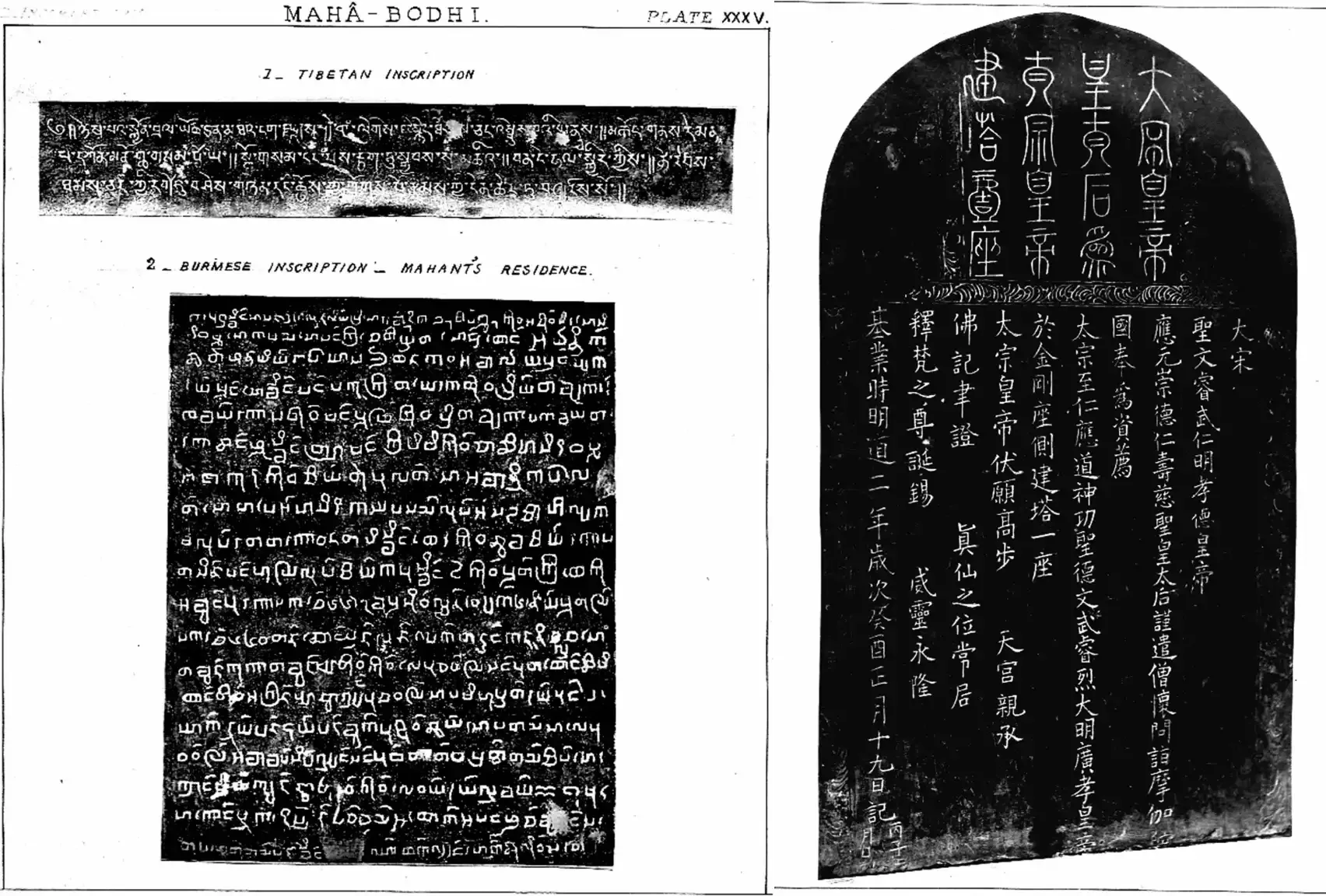
Appropriation of Buddha as a Hindu Deity (Copland 2004)Chinese, Tibetan and Burmese Inscriptions Found in Bodh Gaya (British Museum, Asia)
Because of Buddhism Revival in India thanks to Ambedkar and with lot of support from International Community both Bodh Gaya and Nalanda are today recognized as exclusive Buddhist heritage. But the historical appropriation of the temple by Hindus is still ignored and not taught in history books. But we have our own case of appropriation from Assam itself
Hajo – A Historical Buddhist Temple
Very few people know this that Assam was the place where Buddha died — atleast as per Mahayana and Vajrayana Buddhism. Even Hayagriva is a Vajrayana Buddhist Deity which was appropriated as Vishnu Avatar just like Buddha himself was later appropriated as Vishnu Avatar by Puranas. This was a move to give legitimacy to Hindu colonization and seen as absorption of vastly different schools of thought into the single homogenous Brahmanical religion that we know today.
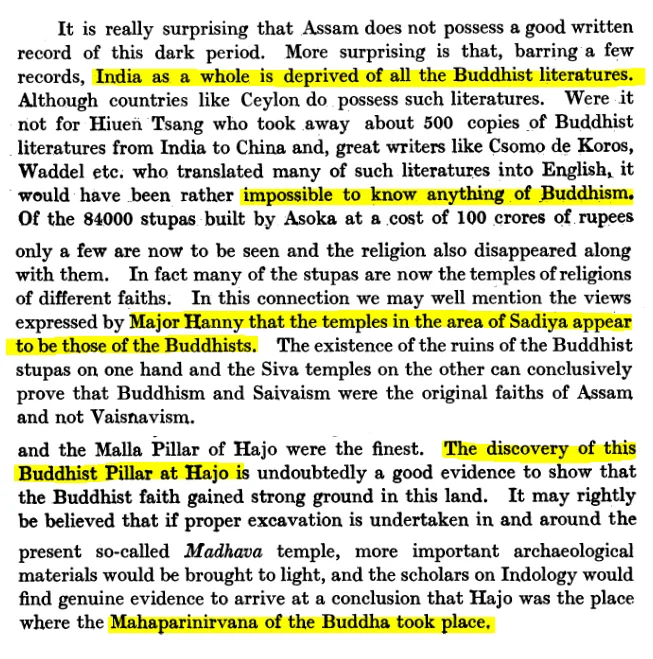
Perhaps the most important evidence of Hajo being a Buddhist site comes from the archaeological survey of the pillar fragments which the locals call as 'Ashoka Pillar' although there is very limited attention paid to it other than YC Talukdar report of 1959.
YC Talukdar, The Buddhist Pillar of Hajo (1959)
Another important evidence comes from Kalika Puran which accepts that the area was earlier ruled by danavas (a jest at the Buddhists or Animists) and the text (75-76th Chapter) explicitly says that Hayagriva was the name of the demon. To properly appropriate the temple it was later rechristened to Hayagriva Madhava temple but according to Buddhist tradition Assam is still regarded as the death place of Buddha and the Tibetan Buddhists still pay annual pilgrimage to the temple which has today been appropriated by Brahmanical Forces.
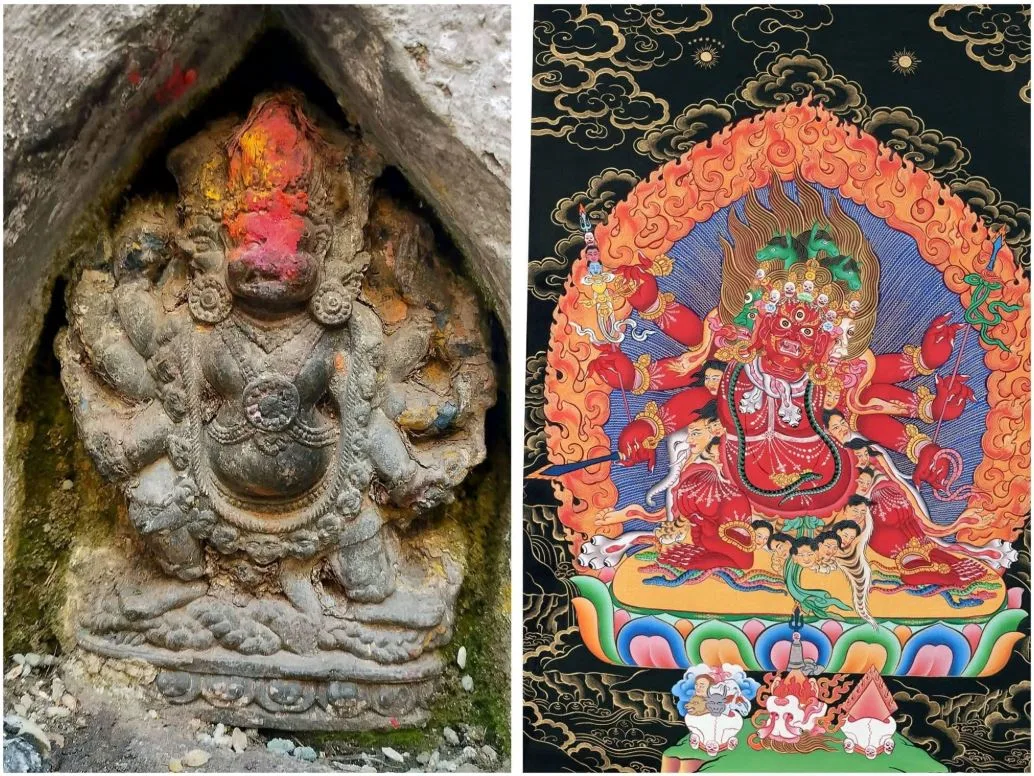
An Idol of Buddhist Deity Hayagriva. This particular form is likely influenced by Atisha Dipankar (10th CE) a Buddhist teacher from Bengal
Self-Victimization of Vaishnavites
If you read newspapers then you will find one column everyday on minorities persecution in India, sometimes the dalits, sometimes tribals and sometimes Muslims and Christians. But ironically the same Hindu Fundamentalists who oppress minorities to chant Jai Shri Ram later claim to be the actual victims. Graham Staines entire family including children were burned alive for doing Missionary Work. Similarly you will find Upper Castes whining about reservation being an injustice to them even though they are competing in the unreserved category (60%) which is more than 2-3 times the General population in India (20-30%), unlike China where the 92% Hans compete for 85% of seats as 15% seats are reserved for 7.5% ethnic minorities. In other words, the Upper Caste people in India are always trying to play victim just like Zionists and we can see this mentality in the Medieval Vaishnavites of Assam as well who used to live in so much delusion that they thought the Buddhists are out to murder them or poison them. And I have read such stories far more times than I can count. First claim persecution, then play victim to justify vengeance — that's one of the oldest fascist authoritarian playbooks.
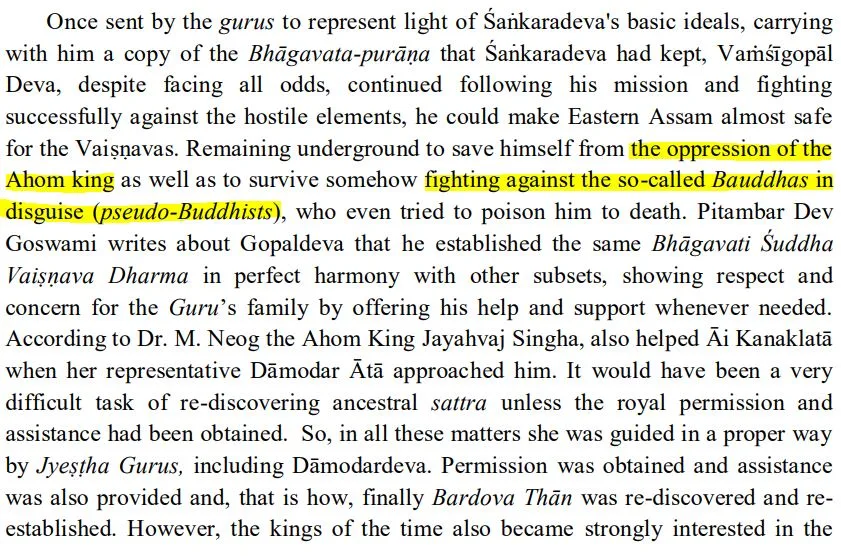
Śrīmadbhāgavatapurāṇa, edited by Pitambar Deva Goswami (1885-1962)
Pitambar Deva Goswami is the same casteist Abbot who headed the Garamur Sattra in Majuli known for following rigid caste system, untouchability and even installing idols and old brahmanical rituals deviating from the teachings of Sankardev (who was against such rituals and idol worship). But in his writings we only see a sense of victimhood that the Vaishnavs were not persecuting the Buddhists or Tribals but rather it was the Buddhists who persecuted the Vaishnavs !! If that is true then where are those Buddhists today? How is it that not a single traditional Buddhist is even alive anymore to say his side of the story?
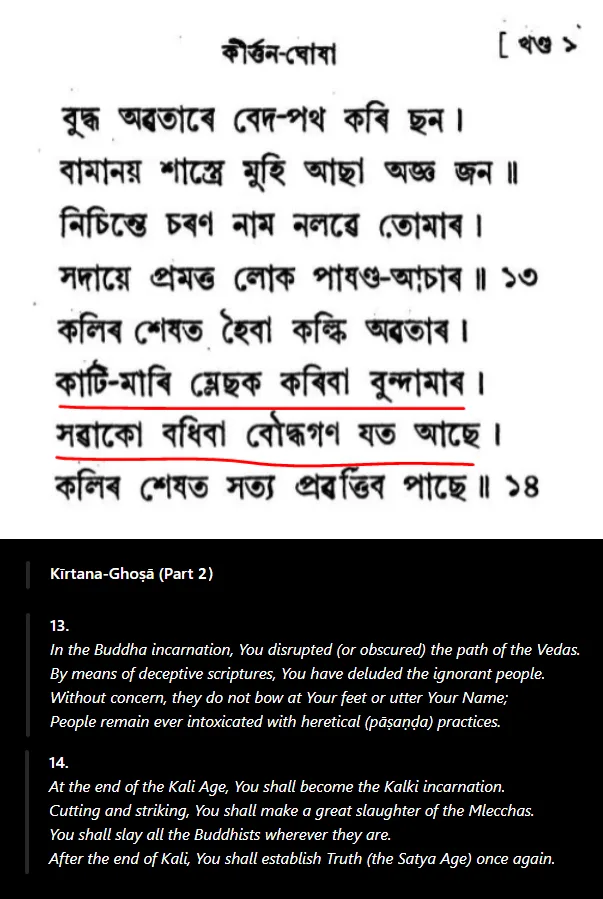
Sankardev urging Kalki to kill Buddhists
Many people try to present Sankardev as a liberal and some people like Marshall Baruah even call him leftist. But the word liberal and leftist denote more of a political position rather than any religious reform. For example there can be some Islamic Reformer in Taliban who has slightly less extremist views that doesn't mean he can be called as a liberal or leftist. In same way Sankardev had slighly different views from traditional Brahmins but he still supported the same social order and same caste hierarchy to oppress the lower castes and particularly the indigenous tribals of Assam. The evidence of this was presented by World Bodo Historical Society (WBHS) which demanded the ban of Kirtan Ghosa and Nam Ghosa, written by Sankardev and Madhavdev which they allege to contain derogatory verses against Bodos and other indigenous people of Assam.
One such verse is from Dwitya Kirtan, Verse 14 of Kirtan Ghosha
কলিৰ শেষত হৈবা কল্কি অৱতাৰ | কাটি মাৰি ম্লেছক কৰিবা বুন্দামাৰ ||সৱাকো বধিবা বৌদ্ধগণ যত আছে | কলিৰ শেষত সত্য প্ৰৱৰ্ত্তাইবা পাছে || ১৪
At the end of the Kali Age, You shall become the Kalki incarnation. Cutting and striking, You shall make a great slaughter of the Mlecchas. You shall slay all the Buddhists wherever they are. After the end of Kali, You shall establish Age of Truth once again.
Dwitiya Kirtan, Verses 13-14, Kirtan Ghosha of Sankardev
Sankardev is as honest as he could be about the Hindu Appropriation of Buddha as Vishnu Avatar who incarnated to mislead people from the path of Vedas, and his entire philosophy is reduced to deception. This is how great intellectual non-Hindu traditions of Ancient India like Charvakas Baudhas Ajivikas etc were wiped out through the sword of mindless Brahmanical traditions and meaningless rituals. Anyone who opposed them were persecuted to the extent that their entire religion became extinct. Buddhism is only one of the religion. Countless tribal religions were wiped out in Assam because of Brahmanism, including the animist Ahom religion. But what many people also don't know is that aside from animism, Ahoms too had their own Buddhist tradition.
The Buddhism of Ahoms
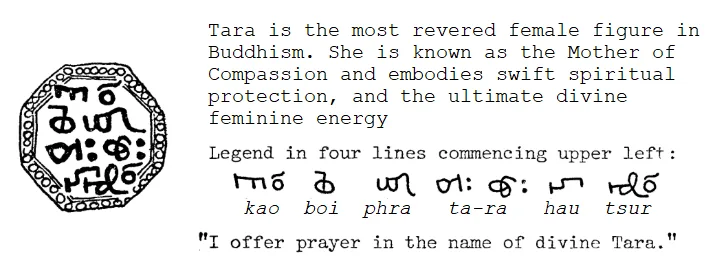
Often ignored in the academic circles is the fact that a good section of Ahoms (Tai people) who came to Assam were Buddhists — atleast a handful of them if not all of them, who brought along with them their own Buddhist Traditions. We have Ahom translation of Jataka Tales, Ahom translation of the Buddhist Ramayana (where Sita is the sister of Rama), and likewise coins paying homage to Phura Tara the most worshipped female Buddhist deity in Buddhism.
A 17th Cenury Ahom Coin paying homage to the female Buddhist Deity Phura Tara (John Deyell 1978)
So the question remains to be asked is what happened to Ahom Buddhism? Why Ahoms despite being the supposed rulers of the land lost their own religion and linguistic traditions? The answer is multi-dimensional. In the Buddhist-Tai Cultural Vocabulary, Assam was called as Veshali-Long or the great vast place where Buddha gave his last sermons but by the time Ahoms came to Assam, Buddhism had already been wiped out by the Brahmanical forces. Moreover the religion best suited for Ahom King's political ambitions was seen as Shaktism and Vaishnavism which blinded the people in mindless worship. The latter was even more effective in its political use as the Vaishnavs saw their King as Swarganarayan or Swargadeo, like an avatar of Vishnu.
Unlike Buddhism which urged you to question everything, the mindless bhakti-worshipping tradition of Hinduism was much more useful to the Ahom Kings which made them patronize Hinduism over Buddhism and ignore their own native animist faith Ban-Phi. It is interesting to note that even other Tai people who migrated much later were forcibly converted to Vaishnavism. For example, in Jorhat there are still many Tai Khamtis and Khamyangs who follow the Sankardev religion because of discrimination against them from Assamese society (including the so-called Ahoms) and infact this was the case throughout Assam before Burma Mission started their missionary activities and re-converted the Tai and Singhpo people of Assam to Buddhism, removing any trace of Hindu. The mission reached out to Ahoms as well but the Hindu fundamentalists within Ahom community chased them out.
Future of Buddhism in Assam
Many people might not know this but the greatest singer of Assam Zubeen Garg as well as the greatest feminist writer from Assam Mamoni Raisom Goswami both were Buddhists.
Zubeen Garg clarified many times that he doesn't like to be identified as a Hindu Brahmin and said in his last interview that he is a Buddhist and if he dies his body shouldn't be cremated and instead just drowned in the Brahmaputra river because he considered himself as son of the Luit. But his wish was not respected by the fanatic Hindu population of Assam and he was forcibly cremated as per Hindu rituals. And in similar way, Raisom Baidew had also asked for her last rituals to be done as per Buddhist traditions. But her family didn't respect her wish and cremated her as per Brahminical rituals.
Two very powerful people from Assam tried to leave Hinduism and adopt Buddhism but the Hindu people didn't let them, and even their own family didn't allow them. So Brahmanical Hinduism is like a quagmire or daldal, once you have become a Hindu it is very difficult to leave Hinduism. Even though many tribals say they are not Hindu still the Hindu people force their religion on them.
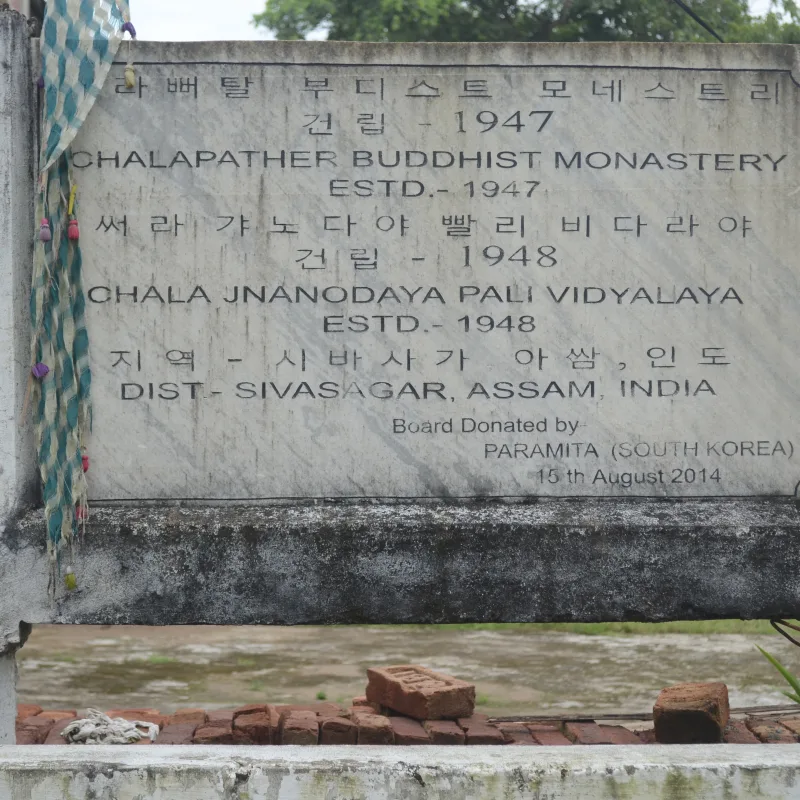
But there are still some revolutionaries like Ambedkar who raised their voice against Hindu Fundamentalism and Ambedkar had famously said "I was born a Hindu but will not die a Hindu." If all people of Assam has such mindset then Buddhist revival is possible. Moreover Buddhists in Assam also have the support from International Community, the Khamyang monastery in Chalapathar, Charaideo for example was reinnovated by the Buddhist Organization Paramita which is based in South Korea. Similarly the King of Thailand regularly send his envoys to greet the Tai Phake people and mark their historical relationship (according to some people, the Phakes are believed to originate from Northern Thailand)
Paramita, South Korean Buddhist Organization Active in Tai Buddhist areas of Assam
But more than any religion what we need is a basic understanding of individual identities and civil liberties. If you don't believe in Quran you are not a Muslim and if you don't believe in Bible you are not a Christian and similarly if you don't believe in Vedas you are not a Hindu. This simple statement will make Assam a non-Hindu state immediately as Assam was never part of the Vedic Janapadas and no indigenous person ever followed the Vedic religion in the land of Assam which was always described in Hindu scriptures as the land of mlecchas, asuras and other non-Aryan people.
And more importantly the debate of Hinduism vs. Buddhism shouldn't dilute Asam's tribal or non-Indic roots. The state support for sattras should be immediately stopped and scientific thought should be encouraged in Assam instead of blind religious practices which gave rise to the popularity of Brahmanical Hinduism in the first place.
References
Samuel Beal, Si-yu-ki, Buddhist Records of the Western World (1884)
Ian Copland, Managing Religion in Colonial India: The British Raj and the Bodh Gaya Temple (2004)
Swami Vivekananda, Lectures from Colombo to Almora (1897)
Pitambar Deva Goswami, Śrīmadbhāgavatapurāṇa, Banlata Publications (2007)
Śaṅkaradeva, Kīrttanaghoṣā, Edited and published by Śrīmanta Śaṅkaradeva Saṅgha, Nagaon
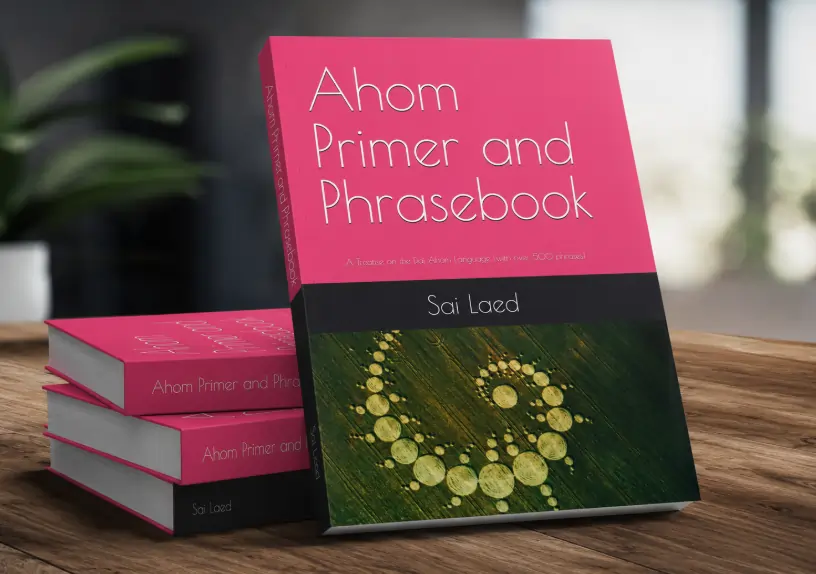

 Learn Ahom