We need your help
Maintaining this site takes time and resources. If you find our content valuable,
please consider supporting us to help cover server costs.
(Even small amounts matter — 100% transparency in donations).
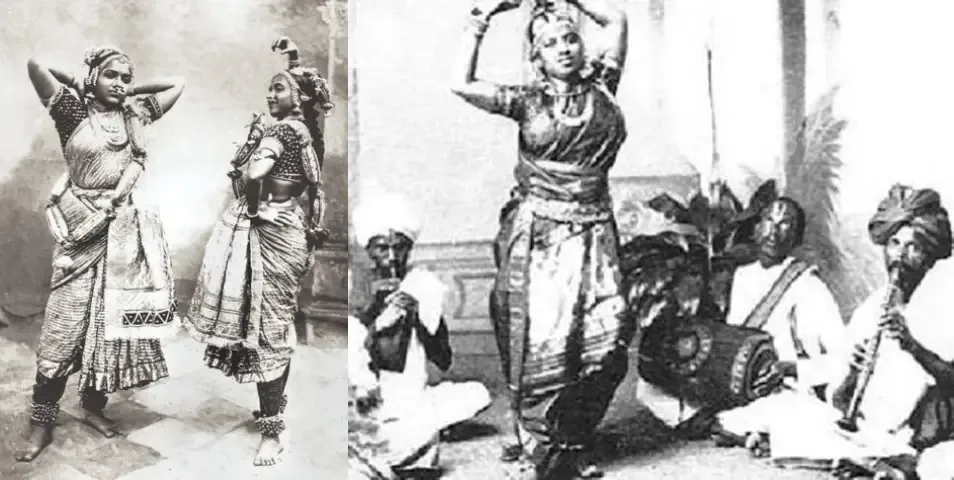
Very few people might know this but Bihu was once considered a vulgar dance-form and the Caste Assamese people even tried to ban it. Similarly the Bharatnatyam was originally a dance of prostitutes (called as devadasi), but with the arrival of British the art-form was 'refined' and many lewd gestures were sanitized to make it more appealing to the Britishers and Christian Missionaries who complained of this lewd and indecent art-form.
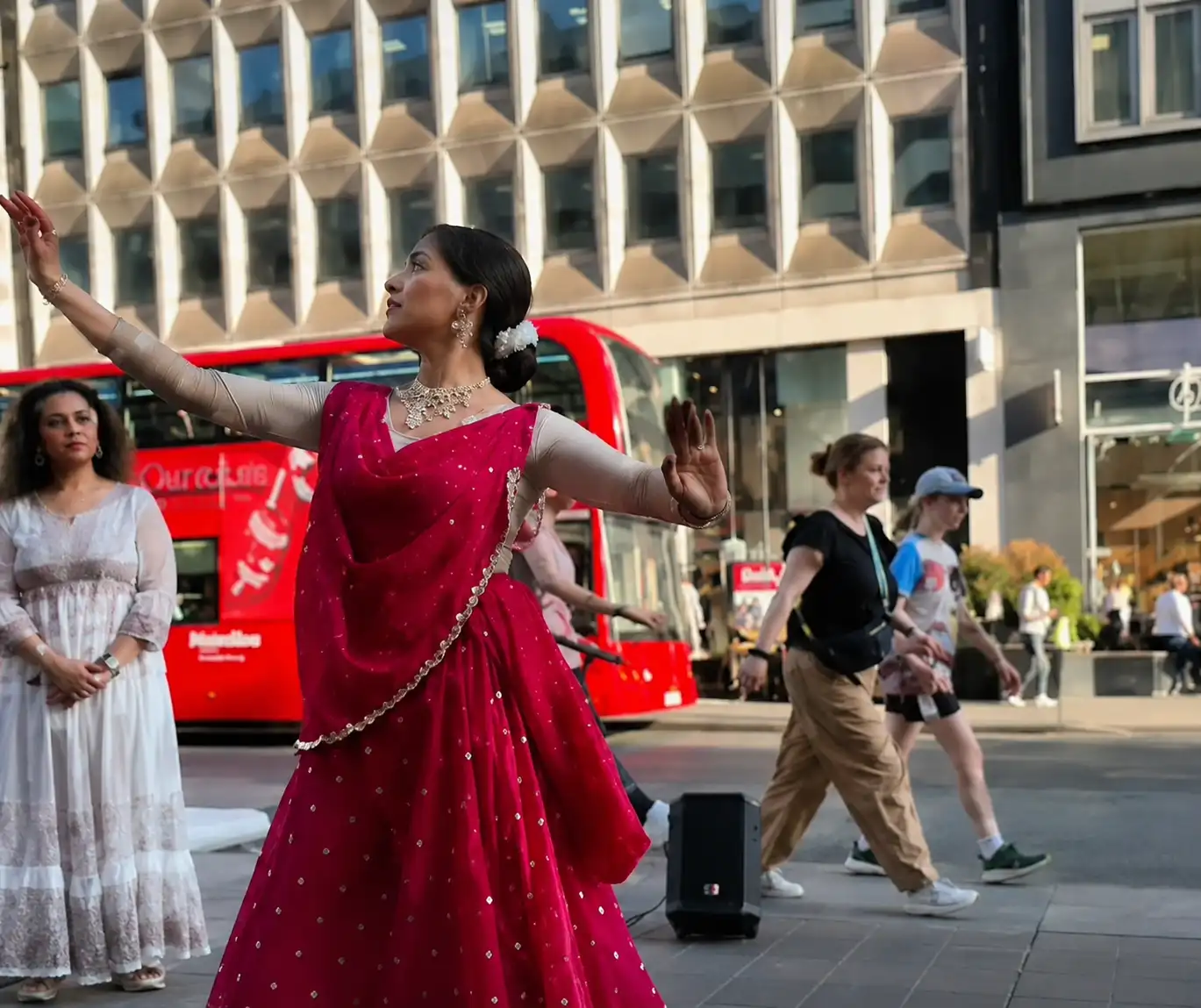
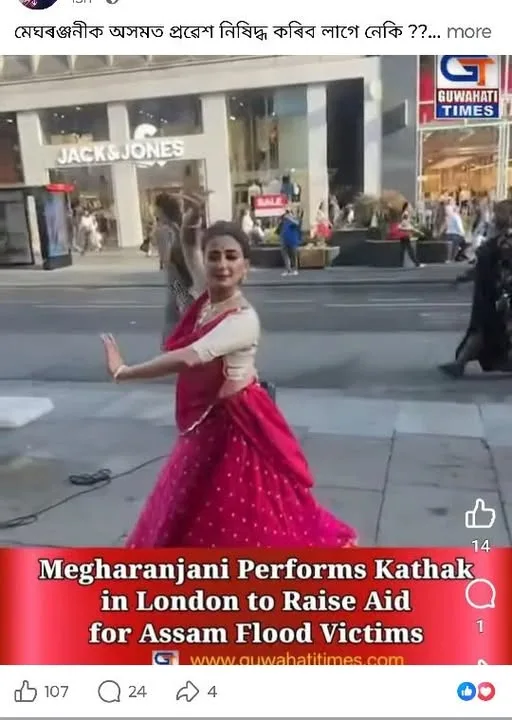
The same is the case with Kathak and the recent criticism directed at Assamese actress Meghranjani Medhi for performing Kathak in the streets of London. One charge labelled against her is that she has insulted the tradition of Kathak itself by taking it to the streets and lowering its status. This statement can only be made by an Upper Caste person which makes the argument no longer about dance but cultural ownership.
And the question to ask here is - Who has the right to perform Indian classical dance, where are they allowed to perform it, and who gets to define what is respectable?
Many Critics sincerely believe that Meghranjani has brought shame to the state of Assam but how exactly?
A classical art-form just like any other art-form does not emerge from a vacuum. Its history is usually a history of different people, which also includes tribal communities and other marginalized groups.
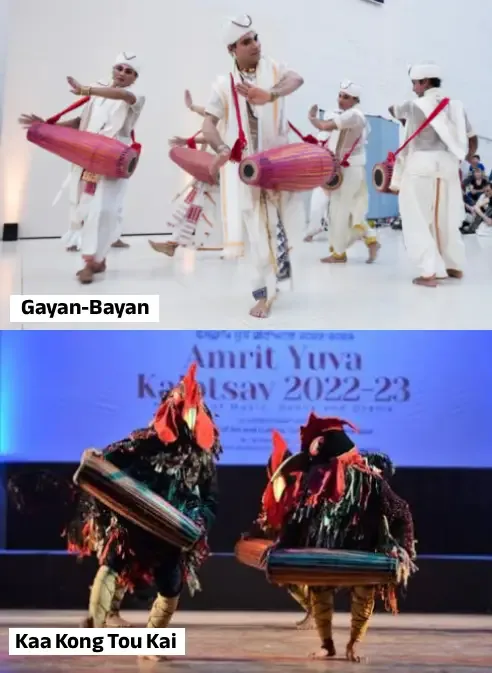
Take for instance the Sattriya-dance form of Assam which is heavily inspired by Ahom dance-forms (especially the Gayan-Bayan. One can pick up any Tai Khamti cock-fight dance video (Kaa Kong Tou Kai) on the internet and see the strong similarities between the two
Similarities between Assamese Gayan-Bayan dance and Cock Fight Dance of Tai-Kadai People
So does an Assamese person have any right to complain if someone takes Sattriya dance to the streets if it is proven that the dance form doesn't even belong to him, but rather merely derived from the traditional Tai and tribal dance-forms of Assam. The same also goes for Kathak.
Refinement vs Cultural Appropriation
As we already saw with Bharatnatyam which was originally a dance for prostitutes but got refined to make a show of 'high-culture' infront of the world, but in Marxist terms we call it cultural appropriation and cultural reclassification where something is taken from an oppressed culture (devadasis) without due credit for the sole benefit of the oppressor culture (the brahmins).
The dance remains the same, but the social prestige attached to it changes once it is associated with the upper castes and no longer seen as a devadasi tradition. Indeed no father might allow his daughter to perform Bharatnatyam once he learns the dark history of this dance (viz. sex-trafficking and forced-prostitution). But they also do not want this dance-form to die, for they see some value in it, which brings us back to the whole concept of refinement (which still is cultural appropriation)
Kathak itself demonstrates this complicated history. Its development involved multiple social worlds, including Hindu temple and storytelling traditions and later Mughal and tawaif traditions. The form we recognize today is thus the product of centuries of interaction of different people from different backgrounds, rather than the property of one homogeneous social group.
The modern stage version is therefore not an untouched fossil from the past. It is a historical construction
From Sadir to Bharatnatyam : How the dance of Devadasis (Prostitutes) became a High-Culture in India
The street suddenly becomes “low”
For the people like Savarnas who have done every worst thing a civilized mind can think of, such as Sati, Devadasi, Female Infanticide, etc, suddenly it is the street dance which is considered low-class and not their own centuries-old thinking.
Kathak was historically performed in Mughal Courts by tawaifs of Heera Mandi, who refined this classical dance to its present recognizable form.
So why should just a London street performance automatically be regarded as an insult to the art? Unless you want to disown the history of the dance form itself.
Moreover who created this hierarchy that stage = respectable, and street = vulgar?? Most of the coolest dance forms have originated in the street, such as breakdancing, popping, locking, etc. If anything the people of Assam and India should be grateful to Meghranjani for taking this dance form abroad and introducing it to thousands of British people who might not even have heard the name Assam.
But for some people, the controversy is not even about dance-form but begging the Britishers (who formerly ruled Assam) and thus it is somehow humiliating for them and shows Assam in bad light. But such people are also mostly the privileged Upper Castes living in cities who have been the least affected by the floods.
The Controversy of Donations
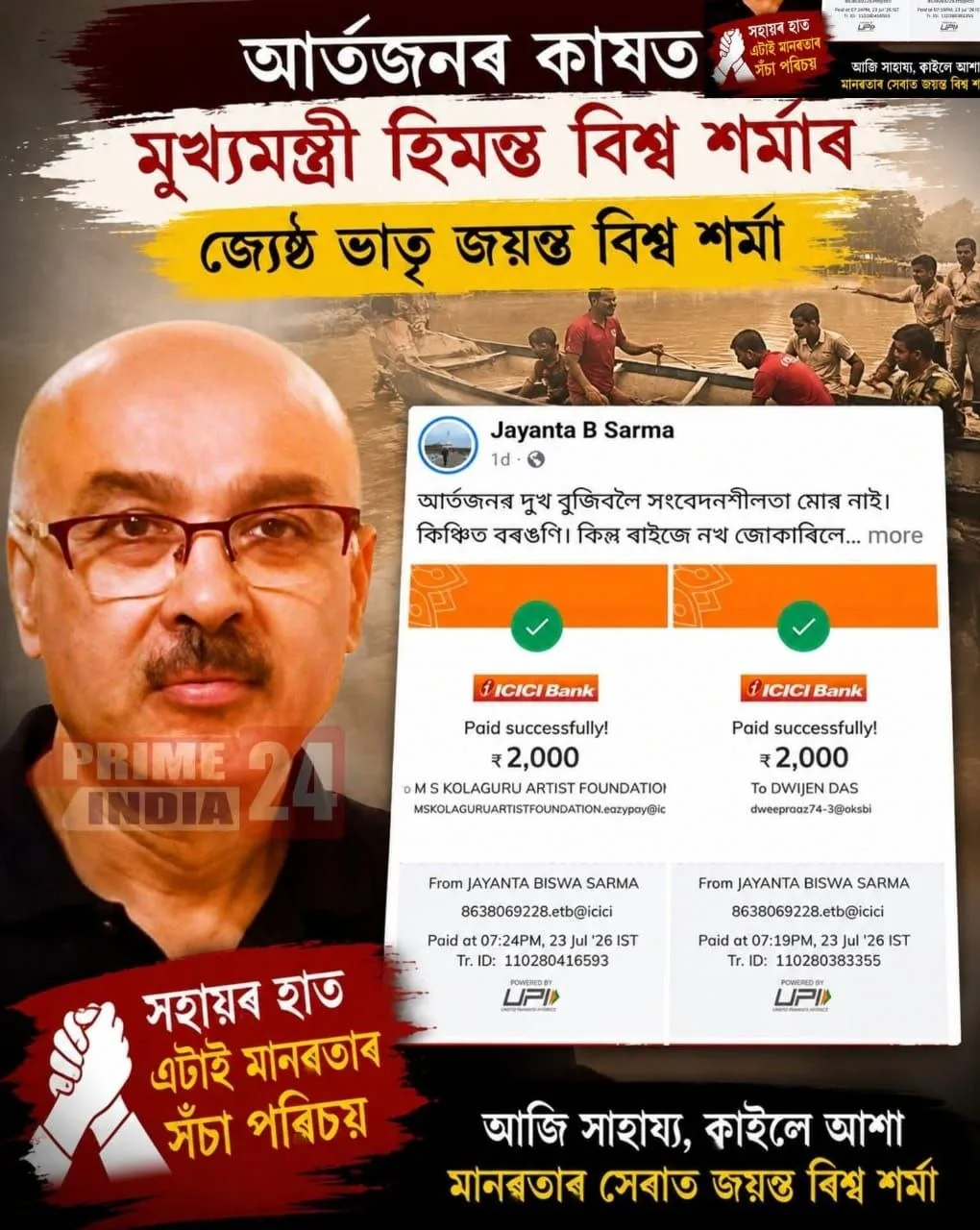
Some well-meaning people are making the point then already so many Indian people are donating to Assam why seek donations from London? The CM Himanta Biswa Sarma straight away called it begging, but didn't mention how his own brother had donated only few dozen pounds to Assam Floods, despite working in the UK as a doctor. Whereas Meghranjani collected thousands of pounds in just few minutes of her performance. That is what is irritating Assam CM the most.
Advertisement
Himanta Biswa Sarma's brother Jayant B Sarma donated £31 GBP for Assam Floods
We are actively seeing many NGOs coming in Assam these days, especially Global Sikhs who came well-prepared and even brought their own boats, life jackets and other relief material. The Assam Government on the other hand appeared to be completely caught off-guarded and one can say that the state machinery has collapsed and failed to do what the NGOs are doing today.
So instead of accepting responsibility, a new convenient scapegoat has been invented that is making Assam feel bad and public anger has now been diverted to Meghranjani Medhi and her crew rather than the failures of the government for providing sufficient relief.
We even showed it in our flood capitalism article how the BJP Government is actually milking the issue by giving Amul Milk, Polyster Mekhela Sadowr sourced from Surat Factories and a huge chunk of money that was dispensed for flood relief is directly going to the pockets of Gujarati Bania Lobby. In fact even in relief materials the Assam Government has inserted BJP's flags so is it even relief or a mere advertisement of the party at the cost of public funds?
Such a morally bankrupt government has no right to question NGOs and ordinary citizens trying their best to help the people of Assam in this crisis.
Understanding Public Anger against Meghranjani
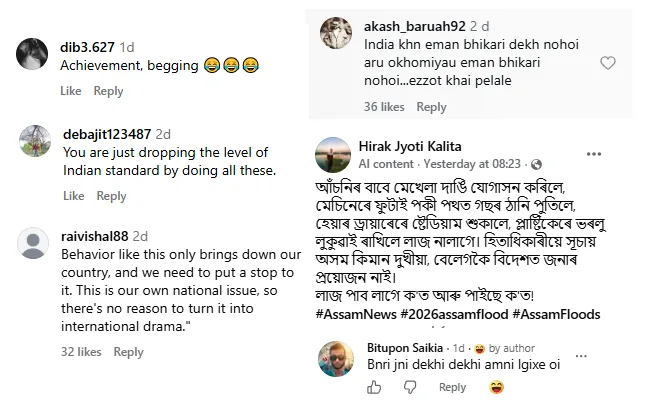
Lot of people have expressed their anger against Meghranjani for what they call as defaming Assam. In fact some people have even talked about banning her from ever coming to visit Assam. Now this is a very normal reaction for those suffering from inferiority complex but living in superiority complex, and I have talked about this in detail in my Assam-Thailand comparison article
Comments against Meghranjani Medhi by Caste Assamese Trolls and other Counter-Revolutionaries
Both Assam and Thailand live in their own bubble and think an awful lot of what other people think about them to the point that they start creating their own delusions of grandeur. Assam suddenly becomes a very rich state with world-famous Muga Silk, Kaziranga, Tea, and what not even though 90% of the world might never even have heard the name Assam. This irrelevance in world politics manifests in many ways. Thailand is also quite irrelevant in world politics so it keeps fighting with Cambodia hoping that the world might notice (my own theory). The most important similarity to Assam is how Thailand which is the Land of Poverty and Land of Inequality tries to rebrand itself as the Land of Smiles.
The monarchy controls practically everything in the country and people are more concerned about the health of the King and Queen than their inability to feed their own family and whenever someone from abroad comes to document the poverty in the country or how thousands of young women in Isaan are forced into prostitution by their parents, suddenly it becomes a national issue where pride of Thailand is being threatened.
Beneath all the grandeur of Bangkok, there are thousands of people who are struggling to make their ends meet and the people of Thailand feel very uncomfortable in facing the reality so they continue to live in the delusion of being the land of smiles and Assam too lives in same delusion, which was thoroughly broken by the catastrophe showing whole world how vulnerable we are and there is no shame in admitting it.
The real shame will be when just for the sake of your own shallow pride, you stop the flow of money into the state, be it the new FCRA regulations targeting Christian Missionaries or anything else. We are living in a world where everyone needs everyone else and injustice against one is an injustice against everyone.
If someone makes fun of our poverty, our destituteness and our helplessness against natural catastrophes then it speaks more about them then it does about us. And absolute worst kind of people are the Caste Assamese Lumpenproletariat who are trolling Meghranjani Medhi.
The word Lumpenproletariat was coined by Friedrich Engels to describe the type of counter-revolutionaries who are disconnected from production and who not just completely lack class consciousness but also actively go against revolutionary interests. The Non-Brahmin Castes of India and the so-called Upper Middle-Class echelon of Assamese society belong to this criteria. Many of them are alleging that Meghranjani was only seeking personal fame, which is a classical argument of counter-revolutionaries that anyone who is trying to bring change in society in any way must be doing it for personal glory.
Such people often advocate for billionaires like Adani Ambani rather than support their own fellow working class people, or the marginalized people below them. And even though these people might have more in common with the poor and destitute they still relate more with the ultra-rich billionaires and look down on the low-income professions. An example of this can be found in the way society treats Hindu Priests (Brahmins) working in temple and how they treat sweepers and cleaners outside that same temple.
When the sweeper asks for some money for their daily sustenance, they are called beggars and are considered a nuisance to society but when the Brahmin asks for thousands of rupees (sometimes even lakhs of rupees) for some useless puja or havan, the middle-class feels obligated and indeed very happy to give him money. But in objective terms, whose labour helped the society more? The Brahmin who just chants useless mantras in a language he himself can't understand, or the sweeper who keeps the surroundings clean and make people want to come to temple (otherwise who will come to a dirty unclean temple)
But in Caste Hindu hierarchy or varna system, the Brahmin is the Supreme and the Sweeper is the lowest, a mere untouchable or chandala. So if such casteist people are showing their anger towards Meghranjani then indeed she must be doing something very good for which we should all appreciate her.
 Learn Ahom