 Learn Ahom
Please go to Ahom Name Generator if you just want a unique name for girls and boys
In this article, we will see some Modern Dai Ahom Names for boys and girls,
Historical Ahom Names
This is an article on modern Dai Ahom names for boys and girls but if you want to know some historical names then please refer this article
One-Syllable Names
Traditionally, Ahoms like all Dai people had only one syllable-names due to monosyllabic
nature of their language. But as population increased, more and more longer names started showing up.
The Thais are particularly known for their super-long names adopted as recently as 1910s,
from Pali-Sanskrit language. This was mainly because of the restriction and limited vocabulary
of core-Tai language. Modern Dai Ahom however solves this same issue by borrowing heavily from
Chinese and Burmese, either in form of loanwords or calque. Lot of Dai names are actually Burmese or
Chinese in origin that way (because Tai doesn't have more than 3000 core-words of which a very small fraction
are naming words)
The issue of creating vast amount of Tai words is thus solved by compounding and particularly affixes - particularly prefixes to
signify birth-order and/or gender and other affixes to just make the name longer while not contributing in anyway
to the overall meaning. For example, in Yang Jom Muang the actual name is only Jom which means
joyful or happy, and rest affixes (yang-white,muang-country) are just added to make the name
longer and unique. Tho there are also some very meaningful bi- and tri-syllable words which we will see later.
For now, let us look at some core-monosyllabic naming words.
| Roman | Ahom | Meaning | |
|---|---|---|---|
 |
Kawng | ko[q | n. drum |
|
Kaew | kVw@ | n. gem |
|
Kham | xmq# | n. gold |
|
Nam | nM$ | n. water |
|
Mo | mUw | n. lily |
|
Mon | mUnq@ | v. happy |
|
Jom | cUmq# | v. be glad, joyful |
|
Wan | bnq# | n. day, sun |
|
Saeng | sV[q | n. diamond |
|
Daeng | dV[q | n. red |
|
Kham | xmq@ | n. evening |
|
Phan | fnq | n. dream |
|
Kyaw | ekia! | adj. happy |
|
Laed | lVtq! | n. sun |
Multi-Syllable Names
| Roman | Ahom | Meaning | |
|---|---|---|---|
|
Sengdao | sV[q d,w | Jewel of the Star |
|
Laingdao | lV[q# d,w | Starlight |
|
Senglee | sV[q lI | Precious Gem |
|
Sengyum | sV[q yuM$ | Smiling Diamond |
|
Sengawn | sV[q Aonq! | Little Diamond |
|
Sengyen | sV[q yCnq! | Gracious Gem |
|
Sengmai | sV[q m]! | New Diamond |
|
Wanmai | bnq# m]! | New Day |
|
Nonkham | nUnq# xmq# | Acacia Flower |
|
Ngaokham | [w# xmq# | Goden Shade |
|
Khampeng | xmq# pV[q# | Treasured Gold |
|
Konkham | konq@ xmq# | Lump of Gold |
|
Konseng | konq@ sV[q | Lump of Diamond |
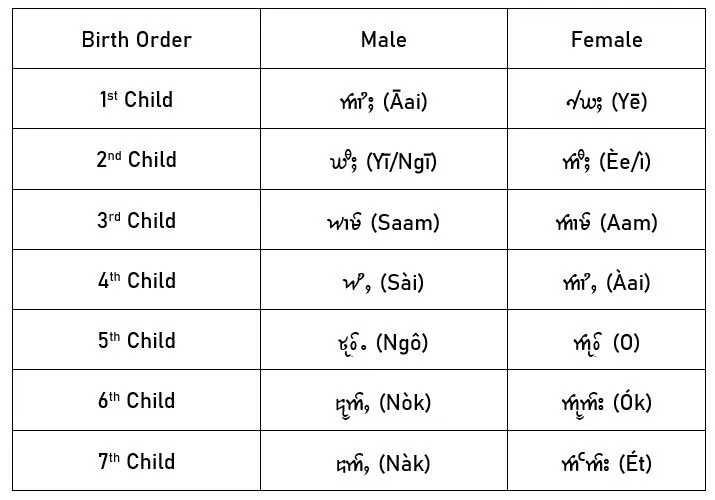
Note that these are all unisex names. Dai names are all ungendered and only through affix (Tsai/Tsao or Nang) we know whether a person is male or female. Aside from general affix, we also have birth-based affix to make names more unique. In the earlier times when Tai people used to have only one syllable name, many siblings ended up having same name. So to distinguish them affixes were added to signify 1st son, 2nd son, 1st daughter, 2nd daughter. etc.