
 Learn Ahom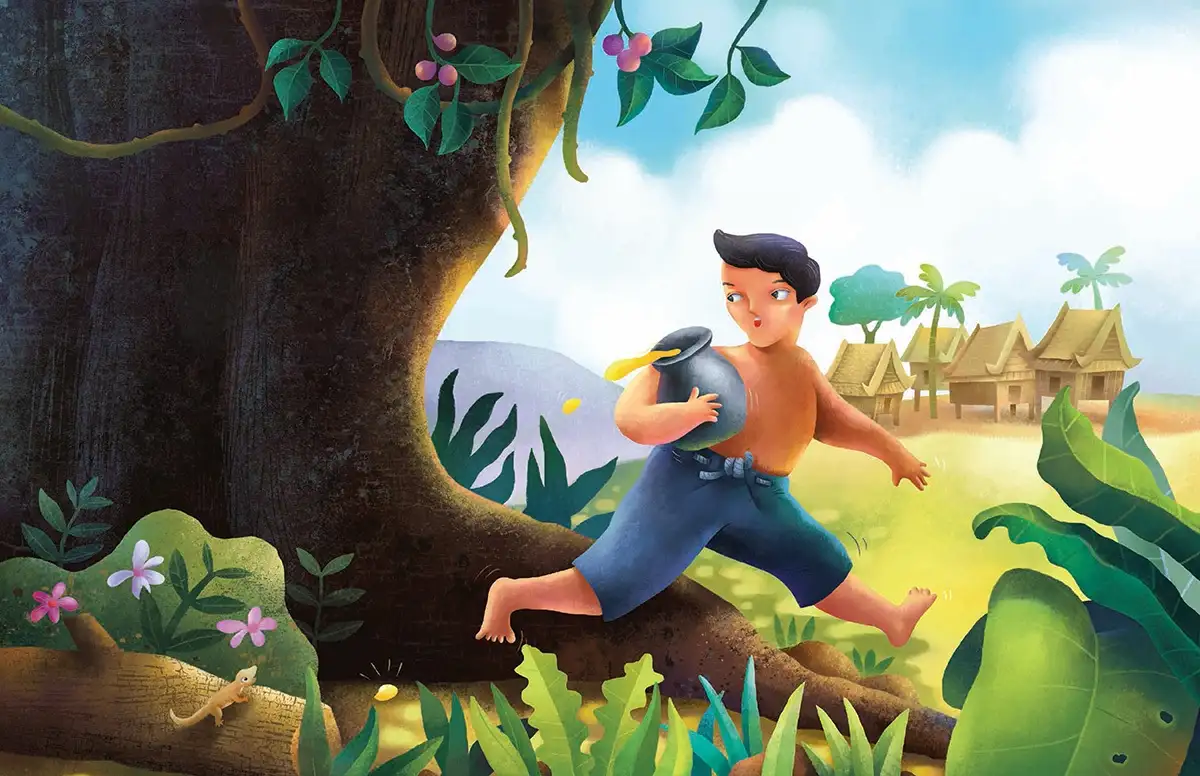
This story is taken from Thai Children's Favorite Stories - Fables, Myths, Legends and Fairy Tales by Marian D. Toth
Once there was a quiet, sleepy village. It was called Peaceful Village because everyone who lived there said, “My neighbor is my friend.” The people worked together each season of the year, in the rain, in the heat, in the dry season. They were always together like bunches of bananas in a tree. Then a terrible thing happened, as quick and unexpected as a flash of lightning in the sky. Peace left the village and these loving neighbors became enemies.
It happened one day long ago when the red sun burned over the horizon and shone on the bamboo huts in Peaceful Village. The roosters crowed, as they always did, and stretched their wings like unfolding fans. The pigs oinked and poked their noses in the earth. The rice farmers washed the sleep from their eyes, rinsed their mouths with water, and chewed a wad of betel nut before going to work in the paddy. The women put yokes on the water buffaloes and woke their sleepy sons. The boys rode on the backs of the buffaloes and guided them to the paddy.
That morning a little chingchok lizard, no bigger than a mouse, slithered onto the dirt road running through Peaceful Village. Its brown body looked like a drop of mud slung from the hoof of a buffalo. The farmers and their sons passed the chingchok on the way to the paddy. The shopkeeper’s sons skipped by it on their way to the wat where they recited their lesson for the priest. No one paid any attention to the chingchok because others just like him were in the houses, the trees and the compounds of every Thai family.
The chingchok fell fast asleep by the side of the road. Nothing disturbed him, not even a little boy carrying a big pot of honey. As the boy skipped down the road, his pot rocked from side to side and a golden drop of honey flew through the air, landing on the sand beside the sleeping chingchok.
This day, long ago, seemed like any other day. The lizard slept, the drop of honey sparkled in the sun, and the housewives went on with their work. They cooked the morning rice, scooped it onto banana leaves, and wrapped it with string, like a present.
The children carried the little green bundles to their fathers in the paddy. Some wives mashed rice into flour with mortar and pestle. Others wove cotton threads into fabric on large handlooms. In one compound, not far from the sleeping chingchok, a woman and her friend sang a little baby to sleep in a cradle.
It’s twelve o’clock my baby, The turtle dove is still; He cries from dawn to noon time But now his voice is still. And you must rest, my baby, For the sun is past the hill.
When the baby fell fast asleep, his mother said to her friend, “Today I saw two chingchok fighting on the wall of our hut.”
“It is an omen of evil. It means your family will suffer illness and maybe death,” said the woman as her face wrinkled into a worried frown. “You must offer rice to the guardian spirit of your place. If you burn incense for him and bring him fresh flowers, he may keep the evil from falling upon you.”
Two little children, a boy and a girl, listened to their mothers’ conversation.
“Run along, little rat, run along, little rabbit,” the mothers said to them. The children skipped down the road arm in arm.
“My mother is terribly worried because the chingchok were fighting on the wall of our house this morning,” said the little girl.
As they passed the sleeping chingchok, the little girl said, “Look, this chingchok is sleeping just an elephant’s step away from my cat.”
“And my dog is sleeping in the shade behind your cat,” said the little boy.
Just then the chingchok opened his beady eyes. The first thing he saw was the drop of honey gleaming in the sunlight. With a fast dart and one quick lick of his tongue he devoured the honey. The scurrying of the chingchok alerted the cat. She caught him with her paw and rolled him over in the sand. The scuffle awakened the dog. He snarled and barked at the cat. She arched her back and hissed like the fuse on a firecracker. The dog growled fiercely. The girl grabbed a stick and beat the growling dog. “Don’t you dare hurt my cat,” she said. The little boy began to beat the little girl and he shouted, “Don’t you dare hurt my dog!”
The girl’s mother came running to the scene. She slapped the boy and screamed, “Don’t you dare hurt my little girl.”
The boy’s mother heard him cry and rushed to the street. “You beast,” she yelled.,“Don’t you dare hurt my little boy.”
Friends of both women came running. When they heard the story, they started to fight, throwing sticks and stones and shouting insults. The women even pointed their toes at their enemies’ heads. Nothing was more insulting than this. The shouting disturbed the ricebirds. They fluttered above the paddies, darkening the sky with their flapping wings.
The farmers heard the scream of a child, the sob of a mother, a wild shout, and an angry roaring of voices. They did not stop to unyoke their buffaloes and let them have an afternoon rest. They did not check their fishing nets and bring home the day’s catch. They did not sit on their buffaloes’ backs and play their bamboo flutes as the animals plodded homeward. The startled men dropped their plowshares and came running. By the time the rice farmers reached the village, the drop of honey, the lizard, the cat, the dog, and the two quarreling children were forgotten. Each man tried to defend his wife and soon found himself furiously fighting his friends and brothers.
The next day the villagers found themselves divided into two camps. Each side dug trenches, and built barricades. For twenty days and twenty nights they fought each other. Brothers killed brothers and fathers killed sons in a meaningless war.
The streets of the village became littered with trash and the houses became dirty and unswept. Weeds choked the rice plants. The water buffaloes’ skin cracked because no one gave them their daily bath. As the days passed it was clear that no one was winning but no one was willing to give up.
Soon the king heard the shocking news that Peaceful Village was at war. He immediately ordered soldiers to quiet the warring village. The villagers were angry that the king was interfering and joined together in an effort to keep the king’s soldiers away.
After many days and many deaths the village became as still as the jungle at dawn. When all was quiet, the king’s soldiers departed. It is said the people in the village felt shame and sorrow.
“How foolish we were,” the people said.
“This must never happen again,” said the village elders.
“Let us learn from the experience and be calm forever more,” said the village
priests.It is said, from that time onward, the Thai people have been calm and eventempered. Their children are taught to be gentle and well mannered, but occasionally, like children everywhere, they are headstrong and act without thinking. Whenever this happens, Thai mothers tell their children about the honey, the lizard, the cat, the dog, and the two quarreling children who started the war in Peaceful Village.