
 Learn Ahom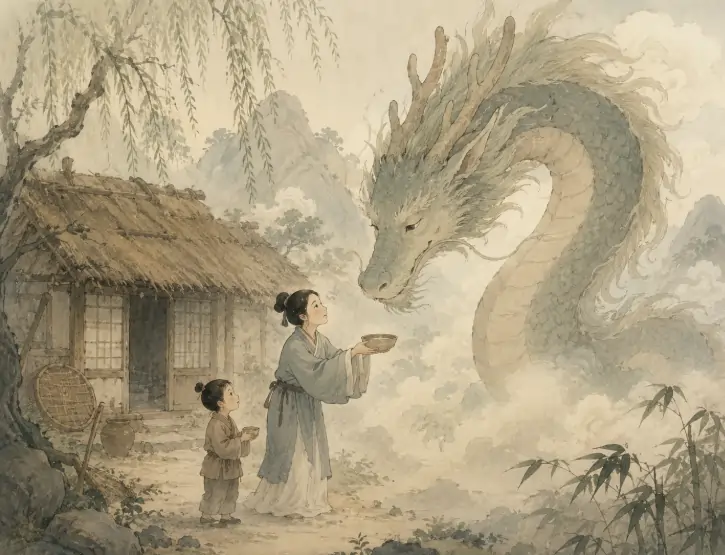
This Story is taken from 试析四则傣族洪水神话, An Analysis of Four Dai (Tai) Flood Myths by Yongxian Qu (2018)
In ancient times, there lived a widow and her young son. Their life was hard. The other villagers looked down on them. While others lived in houses of brick and tile, the widow and her son lived in a hut of bamboo and thatch. While other women had husbands, the widow had none.
Now, there was an old man who was, in truth, a dragon. One day, he decided to descend from the heavens to walk among the mortal world. He wanted to see if there were any good people left. If everyone was wicked, he decided, he would send a great flood to drown all of humanity.
So he transformed himself into an old beggar, carrying an empty basket on his back. His clothes were patched together from many colors—much like the colorful garments of the Hua Lisu people—tattered and worn. In this guise, he went to a Dai village and asked for a place to stay for the night.
He went from door to door, asking every family in the village. But at every house, he was turned away. No one would take him in.
Finally, he came to the widow's door.
The widow said, "Old grandfather, I would gladly let you stay. But our home is very poor. We have no extra bedding. If you do not mind, you may sleep in my bed, and I will cover myself with whatever I can find."
So the old man stayed in the widow's house.
After a while, the old man said, "I am afraid I have a stomach sickness. I fear I may not be able to control myself, and I might soil the bed."
The widow replied without hesitation, "Do not worry. If you need to relieve yourself, do it in the bed. I will wash the bedding afterward."
The old man saw that the widow was truly kind-hearted.
That night, the old man indeed had a bad stomach. He soiled the bedding, just as he had warned. In the morning, he said to the widow, "I have made a mess of your bedding last night. Please take it to the river and wash it."
The widow agreed. Before he left, she asked, "Old grandfather, please eat a little breakfast before you go."
But the old man refused. As he was leaving, he gave her a warning: "A great flood is coming. When it comes, you must climb the highest mountain. Walk upward, and whatever you do, do not look back."
Then he departed.
The widow took the soiled bedding to the river to wash it. But when she unfolded it, she found that the filth was not filth at all—it was gold and silver ingots.
She was astonished. She fell to her knees right there and bowed to the heavens, thanking the gods. She realized that an immortal had descended to test the hearts of mortals—and she had been found worthy.
Remembering the old man's warning, the widow took her son and immediately fled toward the highest mountain. The moment they set foot on the mountain path, the rain began to pour. It rained without stopping for many days. The floodwaters rose and covered the entire Kingdom. Every house in every village was swallowed by the water.
All except one.
Only the widow's little hut remained standing above the flood. Only the widow and her son survived.
Even today, the elders tell this story. They say that old man in the tattered, many-colored clothes was no ordinary beggar—he was the Dragon King in disguise. After all, are a dragon's scales not shimmering with countless colors?
In the hearts of the Dai people, the Hua Lisu are said to be the descendants of the dragon. Their clothes, sewn together from patches of many colors, resemble the dragon's brilliant scales. Around their waists, they wear a belt adorned with shells and cowries. And it is said that only the Hua Lisu can dive down to the bottom of the sea, to the Dragon King's palace, to gather those very shells